
Hidden Fasteners vs. Face Screws: Squeaks, Movement, and Cost Explained
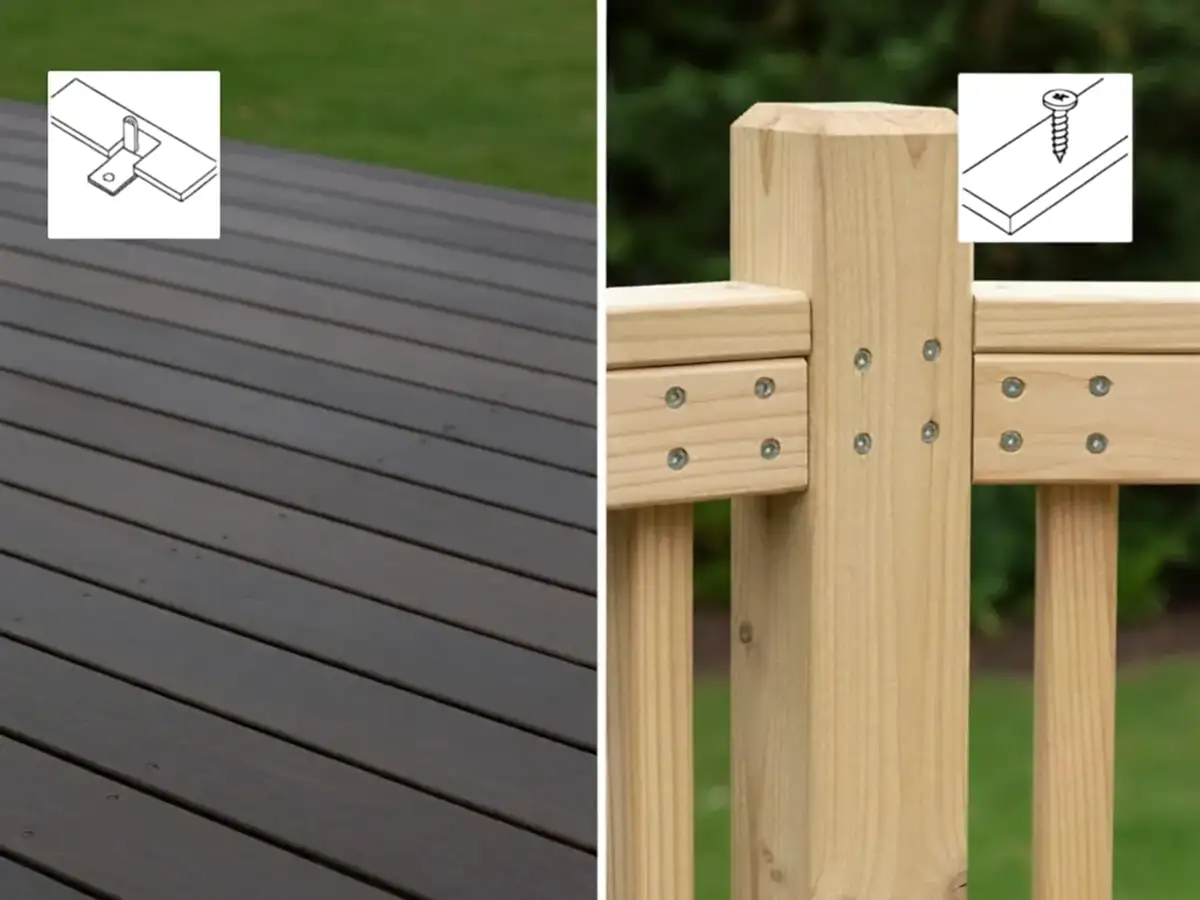
You’ll learn how hidden fasteners and face screws actually hold deck boards, why squeaks happen, how seasonal movement plays into noise and gaps, and what the real-world cost and maintenance differences look like.
The Two Fastening Approaches
What Are Face Screws?
Face screws are driven straight through the top of each deck board into the joist below. It’s the long-standing method for wood and composite decks, and when done correctly (two screws per board at every joist), it locks each board tightly to the frame. That tight mechanical connection helps restrain cupping and board drift.
What Are Hidden Fasteners?
Hidden systems hold boards without visible screw heads on the walking surface. Most use side-groove clips or edge fasteners that set a consistent gap and anchor each board to every joist. The result is a clean, fastener-free surface with uniform spacing between boards.
Common Hidden Systems
- Groove clips that slide into factory slots and screw to the joist from above.
- Edge/side screws that angle through board edges to the joist.
- Screw-and-plug kits that drive a screw from above and cap the hole with a color-matched plug.
These all aim for a smooth look while maintaining the required spacing at each joist.
Squeaks: What Causes Them And How Each Method Behaves
Why Do Decks Squeak At All
Squeaks happen when parts move against each other—board to joist, clip to board, or board to board. Too few or poorly placed fasteners, flexing joists, and tight, unvented installs raise the odds of friction noises. In wood-framed assemblies, inadequate fastening density is a known driver of movement and squeaks.
Face Screws And Noise
Because face screwing pins the board firmly at every joist (two screws), it limits lateral slip and reduces rubbing surfaces that generate noise. Using screws instead of nails also lowers the chance of fasteners backing out and squeaking over time.
How To Keep Face-screwed Decks Quiet
- Pre-drill dense or brittle species to prevent split-induced looseness.
- Use two screws per board at every joist to resist twist and bow.
- Verify joists are stiff and properly spaced so boards don’t flex excessively.
Hidden Fasteners And Noise
Hidden systems allow boards to expand and contract more freely. That’s good for looks, but the extra micro-movement can sometimes produce squeaks if clips, boards, or edges rub—especially when gaps are too tight or ventilation is poor. Professional guidance notes that hidden systems generally permit more board movement than face screwing, which can translate to slight motion or squeaks.
How To Keep Hidden-fastened Decks Quiet
- Use the manufacturer’s clip at every joist and keep the specified board-to-board gap so boards move without rubbing.
- Confirm that under-deck ventilation and ground clearance meet guidance; low clearance/poor airflow can trap moisture and amplify movement/noise.
Movement: Wood vs. Composite/PVC
Wood Decking
Wood swells, shrinks, and can cup as seasons change. Face screws restrain cupping and keep boards flatter; hidden clips let the surface “float” a bit more, which looks clean but can allow minor motion if framing or spacing isn’t dialed in.
Composite And PVC Decking
Engineered boards need expansion gaps and the correct clip types (often a mix of locking and floating clips). Following the installation guide—clip at every joist, correct end gaps—is essential to avoid buckling, humps, or noise. Some makers warn that hidden systems aren’t ideal in very low clearances, on certain stairs, or where ventilation is limited.
Cost: Materials, Labor, And Lifetime Value
Material Cost
Hidden fasteners usually cost more up front than deck screws, often adding about $1 (or more) per square foot, depending on the system. Screws are widely available and less expensive per fastener.
Labor And Installation Speed
Install time depends on crew, tools, and system:
- Some installers find modern clip systems faster than driving thousands of face screws.
- Others find that the learning curve, alignment, and special steps make hidden systems slower.
Expect labor to vary; ask for an install plan and counts (clips per joist, screws per board) before comparing bids.
Maintenance And Future Repairs
- Face screws: Easy to back out a few and swap a damaged board.
- Hidden fasteners: Still serviceable, but you may need to release a run of clips to free one board; plan access accordingly.
Where Each Method Shines
Choose Face Screws When You Want
- Maximum holding power to fight twist/cup on natural wood.
- Simple, predictable installation and easy single-board replacement later.
- Reliable performance on stairs, picture-frame borders, and other details where clips may not be recommended.
Choose Hidden Fasteners When You Want
- A clean, fastener-free walking surface and uniform gaps.
- A system that supports thermal movement of engineered boards while keeping spacing consistent.
- Fewer snag points for bare feet and easier sweeping/washing.
A Smart Middle Ground (The “Hybrid” Plan)
Many builds use hidden fasteners for main fields, then face screw first/last boards, stairs, borders, or problem areas. This keeps the surface sleek while locking down spots that see concentrated forces. Follow board maker guidance for which zones require face screws.
Installation Essentials That Reduce Squeaks (For Any Fastening Style)
Fastener Density And Placement
Hit every joist. For face screwing, use two screws per board at each joist. For hidden systems, use the specified clip at every joist—don’t skip. Correct density stiffens the assembly and cuts friction points that squeak.
Gapping And Ventilation
Respect edge and end-gap charts for your board type, and ensure airflow under the deck. Tight gaps and stagnant air increase seasonal friction and noise.
Substructure Stiffness
No fastener can overcome bouncy joists. Verify joist spacing, blocking, and connections meet modern guidance; a rigid frame supports a quiet, solid feel.
Budget Snapshot (Rules Of Thumb)
- Hidden systems: Expect a premium for clips/fasteners and potentially for labor; a commonly cited range is ~$1+ per sq ft extra just for hardware, varying by product and market.
- Face screws: Lowest material cost; plan on hundreds of screws even for modest decks (often ~350 per 100 sq ft at typical spacings).
FAQs in Brief
Do Hidden Fasteners Reduce Splinters And Snags?
Yes—no exposed heads on the walking surface. That’s a comfort and safety perk many homeowners value.
Can Hidden Clips Cause More Noise?
They can if spacing, clip type, or ventilation is off, because boards are freer to move. Proper gapping, clip-per-joist, and solid framing keep things quiet.
Are Hidden Fasteners Always Allowed?
Some manufacturers restrict them to low-clearance, poorly ventilated areas or on stairs/borders. Always check the board’s installation guide.
Conclusion: Want The Clean Look And A Quiet, Solid Feel?
Intercrus Decks builds with the method that fits your deck’s material, layout, and climate—not a one-size-fits-all rule. We’ll walk you through the trade-offs, dial in framing stiffness, set correct gaps, and choose where a hybrid approach makes sense. The result is a smooth surface, fewer squeaks, and a project that respects your budget and timeline. If you’re planning a new deck or considering an upgrade, our deck builders can help you choose and install the right fastening system the first time. Let’s design a deck that looks great and stays quiet.